
Full Skirt Wedding Dresses: How to Buy Volume That Actually Converts

I have a soft spot for a big skirt.
Not the stiff, swallowing-the-bride kind. Not the skirt that enters the room five seconds before she does. I mean the kind of skirt that makes a bride stand a little taller. The kind that turns a quiet fitting room into a tiny emotional storm.
You know the moment.
The bride steps onto the platform. Her mother stops talking. The stylist reaches for the veil without saying a word. Someone whispers, “Oh.”
That “oh” is powerful.
But here is the part bridal buyers know better than anyone: emotion does not automatically equal conversion.
A gown can photograph beautifully and still sit on the rack. A skirt can look dramatic in a campaign and feel impossible in a real appointment. A ball gown can earn every Instagram save and still lose the bride the second she says, “I feel like the dress is wearing me.”
So the real question is not, “Are full skirt wedding dresses trending?”
They are.
The better question is:
Which full skirt wedding dresses actually help a bridal boutique sell?
That is where buying gets interesting.
Why Full Skirt Wedding Dresses Are Having a Real Bridal Moment Again
Bridal fashion has been dancing between two moods for the last few seasons.
On one side, there is clean minimalism: liquid satin, narrow columns, quiet luxury, no fuss.
On the other side, romance is coming back with a very confident little smile: basque waists, structured bodices, sculpted draping, textured skirts, soft volume, and modern ball gowns that feel less “princess costume” and more “personal statement.”
That shift matters for bridal boutiques.
Recent bridal trend coverage from Vogue has pointed toward more intentional, personality-driven weddings. Brides are not simply copying what looks good online. They want something that feels considered. Something with a point of view. Something that says, “This is me,” without needing to shout.
The Knot’s wedding industry data also shows that brides are still emotionally and financially invested in the dress, but they are shopping with sharper expectations. They want beauty, yes. But they also want value, comfort, movement, photos, and a gown that can carry the whole wedding day.
That is the new pressure on bridal buyers.
A bride may come in saying, “I don’t want anything too big.”
Then she tries on the right full skirt.
Suddenly, she is not anti-volume anymore. She was only anti-bad volume.

The Mistake: Buying Volume as a Silhouette Instead of a Selling Experience
I have seen this happen more than once.
A boutique buyer selects a dramatic ball gown because it looks incredible in a lookbook. The skirt is huge. The train is huge. The photo is huge. Everything says “hero piece.”
Then it arrives in the store.
And real brides start trying it on.
One bride feels shortened. Another feels widened. Another loves the front but cannot imagine dancing. Another says, “It’s beautiful, but it’s too much for me.”
The gown is not ugly. It may even be beautifully made.
It is just not doing enough work for the bride.
That is the buying lesson.
Volume is not just about size. Volume is about proportion, structure, softness, and emotional safety.
A full skirt should give the bride drama without making her feel trapped inside the drama.
Think of it like a chandelier in a small dining room. The right one makes the room glow. The wrong one makes everyone duck.
What Makes Full Skirt Wedding Dresses Convert?
Full skirt wedding dresses convert when they give brides three things at the same time:
A strong emotional mirror moment
A flattering body line
A believable wedding-day life
That third one matters more than people admit.
A bride is not just asking, “Do I look beautiful?”
She is asking:
Can I walk?
Can I hug my dad?
Can I sit for dinner?
Will I feel confident from ceremony to reception?
Will my photos look timeless?
Will my partner recognize me in this?
The dress has to answer yes before she says yes.
That is why the best full skirt wedding dresses do not only create drama. They create confidence.
1. Start With the Waist: The Skirt Only Sells If the Body Looks Balanced
When I look at a full skirt, I do not start at the hem.
I start at the waist.
A full skirt needs a visual anchor. Without it, volume can look loose, heavy, or unfinished. With the right waistline, it becomes flattering, sculpted, and intentional.
That is why basque waists, dropped waists, and long-line corsetry are getting so much attention again. They give the eye a path. They lengthen the torso. They make the skirt feel like it is growing from the body instead of being attached to it.
For bridal boutique buyers, this is where conversion often begins.
A bride may love volume emotionally, but she still wants to feel shaped.
Not squeezed.
Shaped.
Look for:
Basque or soft V-waists that create a longer line
Dropped waist seams that avoid cutting the body too high
Corset-inspired bodices that support without feeling aggressive
Clean waist transitions with no bulky seam buildup
Side profile balance, especially for petite and curvier brides
The side view is the truth-teller.
If the gown looks beautiful from the front but bulky from the side, your stylist will have to work too hard to sell it.
2. Choose Soft Architecture, Not Cardboard Drama
There is a big difference between structure and stiffness.
Structure supports the bride.
Stiffness fights her.
The best full skirt wedding dresses have what I like to call soft architecture. They hold shape, but they still breathe. They create presence, but they do not feel frozen.
This is especially important now because brides are more sensitive to comfort than ever. They are not only buying a ceremony photo. They are buying a whole day of movement, emotion, video clips, hugs, staircases, car rides, and bathroom logistics.
Glamorous? Maybe not.
Real? Absolutely.
A full skirt that converts should move beautifully when the bride turns.
Not collapse. Not bounce like a lampshade. Not drag like a wet curtain.
Move.
For buying, pay attention to:
Layered tulle that creates air, not weight
Organza that holds volume without feeling too dense
Mikado or satin used with clean shaping, not excess bulk
Horsehair hems that add lift and flow
Inner construction that supports the skirt from underneath
A train that looks impressive but can be bustled cleanly
A gown can have volume and still feel light.
That is the sweet spot.
3. Buy for Real Body Diversity, Not Just Sample-Size Fantasy
This is where many “wow” gowns fail in-store.
They look incredible on one body type. Then the selling range becomes narrow.
A full skirt is not automatically flattering for every bride. It depends on the waist, bodice, neckline, skirt angle, fabric weight, and where the volume begins.
For example, a very gathered skirt at the natural waist can look romantic on one bride and overwhelming on another. A box-pleated skirt can feel regal and clean, but if the pleats open too stiffly at the hip, it may add width where the bride does not want it. A soft A-line with controlled fullness can sell across more bodies because it gives shape without shouting.
This is why I always think boutique buyers should separate dramatic volume from commercial volume.
You need both.
But not in the same quantity.
A smart rack might include:
One true hero ball gown for emotional impact
Two soft full A-lines for broader conversion
One clean architectural skirt for modern brides
One romantic lace or textured full skirt for classic brides
One detachable overskirt option for brides who want two looks
That mix gives stylists flexibility.
And flexibility sells.
4. The Neckline Has to Modernize the Skirt
A full skirt can turn old-fashioned quickly if the bodice does not pull it forward.
This is why modern necklines matter.
A strapless cat-eye neckline, a clean scoop, a square neckline, an off-shoulder fold, or a sculpted corset bodice can make a big skirt feel fresh instead of nostalgic.
The goal is not to erase romance.
The goal is to edit it.
A full skirt already carries drama. The bodice should give the bride identity.
Ask yourself:
Does this gown feel modern from the waist up?
Could a stylist describe it in one clear sentence?
Does the neckline create a strong photo moment?
Does it support real brides, not just runway posture?
Can it work with a veil, gloves, sleeves, or a detachable piece?
A full skirt with a weak bodice is like a beautiful story with a forgettable first sentence.
The bride may admire it.
But she may not remember it.
5. Detachable Volume Is One of the Safest Buying Strategies
Here is the truth: many brides want drama and practicality.
They want the aisle moment.
They also want to dance.
They want the royal entrance.
They also want to feel like themselves at the reception.
This is why detachable styling continues to matter in bridal buying. The modern bride often wants a gown that can shift with the day: ceremony, portraits, reception, and maybe even a second look.
For boutiques, this is not just a trend.
It is a sales tool.
A detachable overskirt lets the stylist say:
“You can have the full ceremony look, then remove the skirt for a cleaner reception silhouette.”
That sentence solves a problem.
And in sales, solved problems create confidence.
Detachable volume is especially useful when:
The bride loves a fitted gown but wants ceremony drama
The venue calls for grandeur, but the reception is more relaxed
The bride is torn between two silhouettes
The boutique wants higher perceived value without adding too many SKUs
The stylist needs a strong “second reveal” during the appointment
It also photographs well in social content.
One gown, two moods.
Brides understand that instantly.
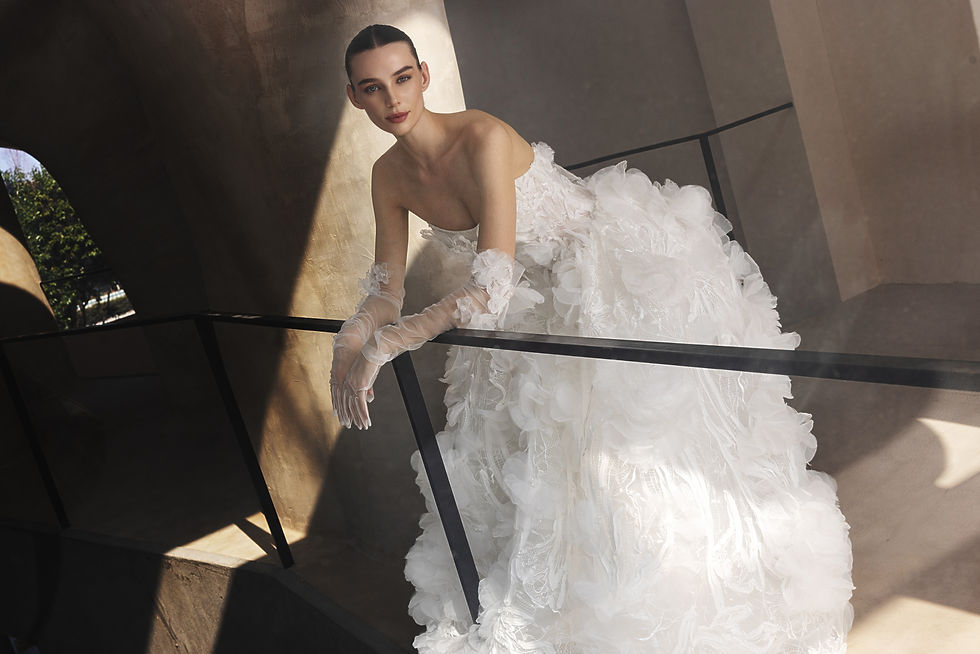
6. Do Not Underestimate Clean Full Skirts
Not every full skirt needs lace, sparkle, or 3D flowers.
In fact, some of the strongest commercial full skirt wedding dresses are clean.
A clean full skirt gives the bride room to imagine herself. It also gives the boutique more styling options: pearl veil, lace bolero, gloves, cathedral veil, bow, detachable sleeves, statement earrings, or a dramatic bouquet.
Clean does not mean plain.
Clean means the line has to be excellent.
The seam placement has to be right. The fabric has to photograph well. The bodice has to fit. The skirt has to fall with confidence.
A clean full skirt exposes construction.
There is nowhere to hide.
That is why buyers should inspect:
Waist seam smoothness
Bust support
Back closure quality
Train shape
Fabric recovery after steaming
How the skirt hangs after movement
Whether the gown keeps its shape after several try-ons
A beautiful sample has to survive real boutique life.
Because bridal samples work hard. They get clipped, stepped on, hugged, cried in, steamed, pinned, photographed, and tried on by brides with very different bodies.
A full skirt sample must be sturdy enough for the job.
7. Think in “Appointment Moments,” Not Just Inventory Slots
This is one of my favorite ways to buy.
Instead of asking, “Do we need another ball gown?”
Ask:
What moment will this gown create in an appointment?
A strong full skirt can serve different purposes:
The “I didn’t think I wanted this” surprise gown
The mother-approved classic gown
The modern royal gown
The romantic garden gown
The clean cathedral gown
The detachable two-look gown
The high-drama social media gown
The softer full A-line that closes the sale
When every gown has a job, your rack becomes easier to sell.
When gowns overlap too much, stylists get stuck.
I have seen buyers fall in love with five different dramatic skirts that all serve the same bride. The result? The rack looks beautiful, but the conversion range is too narrow.
The goal is not to buy more volume.
The goal is to buy better reasons for volume.
8. The Best Full Skirts Feel Emotional Before They Feel Expensive
This may sound simple, but I believe it deeply.
A bride does not fall in love with a gown because the fabric has a technical name. She falls in love because, for one second, she sees the wedding become real.
The research side supports this too. Consumer studies on wedding dress selection often point to symbolic value, emotional context, family opinions, personal identity, and the bride’s own idea of who she wants to be on that day.
In plain English: the dress is not just a dress.
It carries memory, family, beauty, pressure, hope, and a little bit of magic.
That is why the fitting room matters so much.
Full skirt wedding dresses create a physical feeling. The bride can see the aisle. She can imagine the photos. She can feel the ceremony begin.
But the dress still has to let her breathe.
That is the line buyers have to walk.
Emotion, without intimidation.
Drama, without costume.
Presence, without heaviness.
9. What I Would Avoid When Buying Full Skirt Wedding Dresses
A few red flags:
Too much skirt, not enough bride.If the gown overwhelms the face, neckline, or waist, it may get compliments but not commitments.
Heavy fabric without movement.A skirt that looks rich but feels exhausting will lose brides during the try-on.
Overdesigned bodices.If the skirt is full and the bodice is busy and the train is dramatic and the sleeves are huge, the bride may disappear.
Poor bustle planning.If your stylist cannot explain the bustle easily, the bride will imagine problems.
A narrow body-type range.If the gown only works on one very specific bride, buy it intentionally as a hero piece, not as a core seller.
Trend without reason.A basque waist is beautiful. A drop waist is beautiful. A bubble skirt can be fun. But if the design does not flatter, support, and move, the trend will not save it.
10. A Practical Buying Checklist for Volume That Converts
Before adding full skirt wedding dresses to your boutique assortment, ask:
Does the gown create an emotional mirror moment?
Is the waistline flattering from the front and side?
Does the skirt move well when the bride walks and turns?
Is the sample weight realistic for appointments?
Can the gown be styled in more than one way?
Does it photograph well in both full-length and close-up content?
Is the bodice strong enough to support real brides?
Does the skirt shape work across multiple sizes?
Can the stylist explain the gown in one sentence?
Does it add something new to the rack?
Can it justify its price through design, construction, and experience?
Will a bride feel beautiful, comfortable, and still herself?
That last one matters most.
Still herself.
Because the best bridal gown does not turn a bride into someone else. It turns the volume up on who she already is.
Where Calista Couture Fits Into the Full Skirt Conversation
At Calista Couture by Cheyenne Tsai, I think about volume through the lens of real boutique selling.
A full skirt should never be just “big.”
It should be balanced. Sculpted. Emotional. Wearable. It should help a stylist tell a story in the fitting room. It should give the bride a reason to pause, smile, and maybe get a little quiet.
Our design language is rooted in American originality with French couture influence: clean structure, romantic softness, thoughtful construction, and details that support the boutique selling experience.
For full skirt wedding dresses, that means paying close attention to waistline, proportion, detachable styling, movement, and the way a gown feels on real brides—not just how it looks in a campaign image.
Because in the end, the gowns that convert are rarely the loudest gowns in the room.
They are the ones that make the bride feel seen.
And when that happens, everyone in the boutique feels it.
Even before anyone says yes.
FAQ: Full Skirt Wedding Dresses for Bridal Boutiques
Are full skirt wedding dresses trending again?
Yes. Full skirt wedding dresses, modern ball gowns, basque waists, drop waists, sculpted draping, and romantic A-line silhouettes are all part of the current bridal conversation. The key is to buy volume that feels modern, wearable, and emotionally connected to the bride.
What type of full skirt is most commercial for bridal stores?
Soft full A-line gowns are often the most commercial because they offer romance and movement without overwhelming the bride. A boutique can then add one or two stronger ball gowns or detachable overskirt styles for drama.
Should bridal boutiques buy ball gowns or detachable overskirts?
Both can work, but they serve different purposes. Ball gowns create a strong emotional try-on moment. Detachable overskirts give brides flexibility and can help stylists sell two looks in one gown.
What makes a full skirt wedding dress flattering?
The most flattering full skirt gowns usually have a strong waistline, balanced bodice, controlled volume, clean side profile, and enough structure to support the bride without making the dress feel stiff or heavy.
How many full skirt wedding dresses should a boutique carry?
It depends on the boutique’s customer base, price point, local venues, and overall assortment. A balanced rack often includes one dramatic hero gown, several softer A-line or ball gown options, and one convertible or detachable-volume gown.
Author Bio:Cheyenne Tsai is the designer behind Calista Couture, an original American bridal brand known for sculpted structure, romantic softness, and designer-led gowns created for modern bridal boutiques.


Comments