
Bridal Corsetry Trend Without Costume: How Boutique Buyers Should Read the Trend

Corsetry is back.
But before anyone panics and imagines stiff costumes, theatrical bodices, or gowns that look more like a period drama than a modern wedding dress, let me say this first:
The best bridal corsetry trend is not about costume. It is about structure.
That difference matters.
A lot.
In bridal fashion, corsetry can go wrong very quickly. One extra seam, one overly obvious bone channel, one bodice cut a little too aggressively, and suddenly the gown stops feeling elegant. It starts feeling like a character.
And unless the bride is intentionally asking for that kind of look, most boutique buyers know the danger.
Fashion-forward is good.Overdone is risky.Costume is where sell-through quietly goes to die.
Still, I understand why corsetry has returned with such force. Recent bridal fashion coverage has repeatedly pointed to basque waists, exposed boning, long-line corsets, and sculpted bodices as important directions in bridal design. Vogue highlighted draped basque waists and corset-like separates in its Spring 2026 bridal trend report, while Brides noted exposed boning and basque waists as major runway themes. The Knot’s 2026–2027 trend coverage also pointed to exposed corsetry and long-line corsets as visible bridal directions.
But here is what I always tell myself when looking at a trend:
Runway attention is not the same as boutique value.
A trend can be beautiful in photos and still be difficult on the sales floor.
So the real question for boutique owners, buyers, merchandise managers, and senior stylists is not simply, “Is corsetry trending?”
The better question is:
“Which version of corsetry can my bride actually say yes to?”
That is where this conversation gets interesting.

Why the Bridal Corsetry Trend Is Back
Corsetry returned because brides are craving shape again.
After seasons of soft tulle, sheer layers, slip dresses, relaxed silhouettes, and barely-there construction, many brides are reaching for gowns that make them feel held.
Not trapped.
Held.
There is a difference.
I have seen this in fittings and market appointments many times. A bride or buyer will first gravitate toward something soft and romantic on the rack. Then she tries on a gown with a real bodice — something with lift, waist definition, and a clean line — and the room changes.
She stands taller.
Her hand goes to her waist.
She looks in the mirror for a little longer than expected.
That little pause tells you everything.
A corset bodice does something soft gowns often cannot do by themselves. It gives the body a frame. It supports the bust. It defines the waist. It creates proportion. It gives the gown a beginning, middle, and end.
Almost like a good story.
And brides remember stories.
They remember how a dress made them feel. They remember the one that gave them posture. The one that made their mother stop talking. The one that made the stylist smile before saying a word.
That is why the bridal corsetry trend is not only a runway detail.
It is emotional.
It is physical.
And when interpreted well, it is very sellable.
Corsetry Without Costume: The Key Buyer Question
Here is the line every buyer has to watch:
Does the corsetry make the bride look supported, or does it make her look styled as someone else?
That is the heart of it.
A corset bodice wedding dress can feel modern, romantic, clean, sensual, classic, or editorial. But when the design becomes too literal, it can start to feel like a costume.
You know the look.
Too much visible boning.Too much contrast.Too much historical reference.Too much drama with not enough bride.
It may photograph well on a model. It may get attention on social media. It may even stop people at market.
But will your bride wear it to a chapel wedding in Dallas?A vineyard wedding in California?A coastal ceremony in Florida?A garden estate wedding in South Carolina?A refined ballroom wedding in New Jersey?
Maybe.
But maybe not.
This is where strong buying judgment matters.
The best boutique buyers are not trend followers. They are translators.
They look at the runway and ask, “How does this become wearable for my bride?”
That is how to read corsetry.
Not as a costume reference.
As a structure language.
What Makes a Corset Bodice Commercial?
A commercial corset bodice does not need to scream, “Look, I am a corset.”
It needs to make the bride feel secure.
That is much more powerful.
For boutique buyers, a strong corset bodice wedding dress usually has a few things working together:
A flattering waistline that shapes without squeezing
Clean bust support that feels secure in motion
Balanced boning that creates structure without looking harsh
A bodice length that flatters the torso instead of cutting it awkwardly
A skirt transition that feels natural, not heavy or forced
A design mood that still feels bridal, not theatrical
The last point is important.
Bridal corsetry should still feel like bridal.
Yes, it can have edge.Yes, it can have confidence.Yes, it can have sensuality.
But it should still carry softness, ceremony, and emotion.
A bride is not buying a corset. She is buying the feeling of becoming herself on one of the most photographed days of her life.
That is why the best corsetry is often quieter than people expect.
It does not overpower the gown.
It holds it together.

Exposed Boning: Beautiful or Too Much?
Exposed boning is one of the most visible parts of the current bridal corsetry trend.
And I have a complicated relationship with it.
When it is done well, exposed boning can look incredibly refined. It gives the gown architecture. It adds vertical lines. It can make lace feel more modern and sheer fabrics feel more intentional.
But when it is done poorly, it can look unfinished.
Or worse, cheap.
That is the risk.
For buyers, exposed boning should be judged up close, not just in campaign photos. Look at the finishing. Look at the seams. Look at whether the boning feels integrated into the design or simply placed there because the trend says so.
A good exposed-boning gown should answer these questions:
Does it look elegant from three feet away?
Does it still look beautiful up close?
Does the boning flatter the bride’s torso?
Does the transparency feel tasteful?
Does the gown still feel bridal under normal boutique lighting?
Can your stylist explain it without sounding defensive?
That last question may sound funny, but it is real.
If your stylist has to explain too much, the dress may be working too hard.
A bride should not need a lecture to understand why a gown is beautiful.
She should feel it first.
Then the stylist can explain.
Basque Waists: The Softer Side of Corsetry
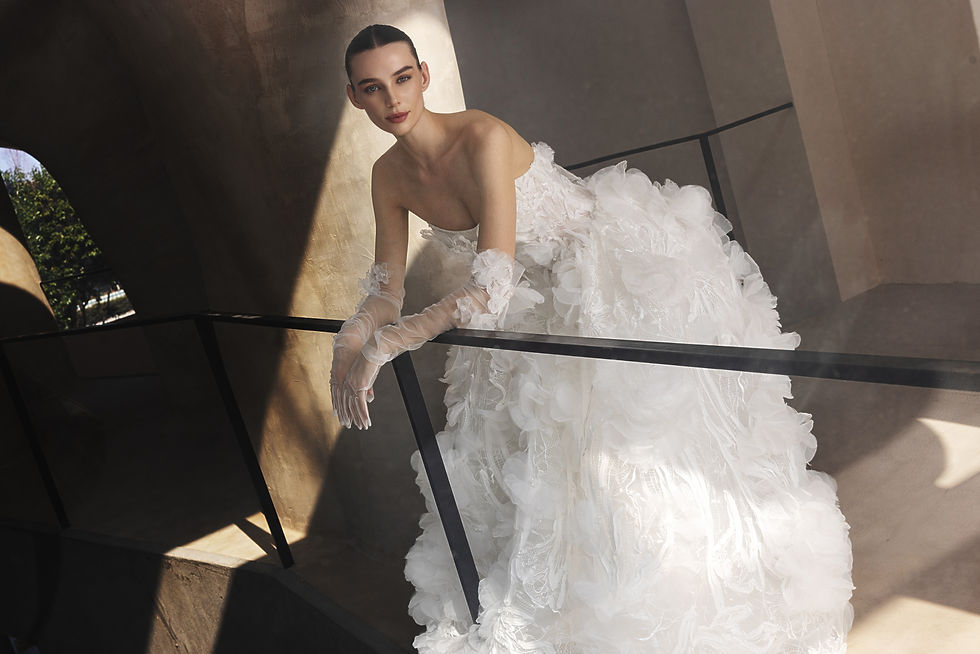
If exposed boning is the bold side of corsetry, the basque waist is the more romantic side.
A basque waist dips below the natural waist, often in a soft V or U shape. It elongates the torso and gives the gown a sculpted line. It feels historical, yes, but not necessarily old-fashioned.
That is why it is working again.
The basque waist gives brides shape without needing the entire bodice to look like lingerie. It can be clean, regal, romantic, or quietly dramatic.
For boutiques, this is useful because a basque waist can speak to many bride types:
The classic bride sees elegance.The romantic bride sees softness.The fashion bride sees shape.The practical bride feels support.The stylist sees a talking point.
That is a good combination.
The best basque waist wedding dresses do not feel like they came from a museum. They feel fresh because the proportions are cleaner, the fabrics are lighter, and the styling is less heavy.
A basque waist with mikado can feel architectural.With lace, it feels romantic.With tulle, it feels soft.With a detachable overskirt, it feels versatile.
That is why I think basque waists are one of the most boutique-friendly ways to interpret the corsetry trend.
They give the bride shape.
But they do not shout.
The Danger of Buying Only for Instagram
Let’s be honest.
Some corset gowns are made for the camera first.
They look incredible in one photo. The lighting is perfect. The model is tall. The pose is sharp. The gown gives drama. Everyone saves the image.
Then the dress arrives in a real boutique.
The lighting is different.The bride is not posing like a campaign model.Her mother is standing six inches away from the bodice.The stylist has to clip the back.The bride wants to sit down.
Suddenly, the trend has to prove itself.
This is where buying only for Instagram can become dangerous.
A gown that photographs well is important. Of course it is. Brides care deeply about photos. But a wedding dress also has to survive real life.
A bride has to move in it.
She has to breathe in it.
She has to hug people in it.
She has to feel beautiful when she is not posing.
That is why boutique buyers should judge corsetry in motion, not just in still images.
Ask yourself:
Does this gown still look beautiful when the bride relaxes?
That question will save you from a lot of mistakes.
How Senior Stylists Can Sell Corsetry Without Making It Awkward
Corsetry can feel intimidating to some brides.
The word itself can sound a little severe. Some brides hear “corset” and think of discomfort, pressure, or something too revealing.
That is why the stylist language matters.
Instead of saying:
“This has a corset.”
Try saying:
“This bodice gives you support and shape, so you do not have to keep adjusting the dress.”
Instead of:
“The boning is exposed.”
Try:
“These vertical lines give the gown structure and make the waist feel more defined.”
Instead of:
“This is very trendy.”
Try:
“This gives you a modern shape, but it still feels bridal.”
Small language changes can make a big difference.
Brides do not always want trend vocabulary.
They want reassurance.
They want to know: Will I look beautiful? Will I feel comfortable? Will this dress stay in place? Will I regret choosing something too bold?
A good stylist can take the fear out of corsetry.
She can make it feel useful.
Because at its best, corsetry is not a gimmick.
It is support.
What Boutique Buyers Should Look for at Market
When reviewing the bridal corsetry trend at market, do not only look at the front view.
Look at everything.
Look at the side seam.Look at the back.Look at the waist placement.Look at the inside of the bodice if you can.Look at the transition from bodice to skirt.Look at whether the gown feels balanced on a real body.
A corset bodice can look exciting on a hanger, but the real test is fit.
Here are the buyer questions I would keep in mind:
Is the corsetry flattering or just decorative?
Does the bodice support the bust naturally?
Does the waist placement work for different body types?
Is the look too sheer for my market?
Can my alterations team work with this construction?
Does this gown offer enough emotional softness?
Does it fill a gap in my current collection?
Can my stylists sell this confidently?
That last question is everything.
A gown can be beautiful, but if your stylists do not believe in it, it will sit.
The right corset gown should make your team excited to pull it.
Not nervous.
The Best Corsetry Has Softness Around It
Corsetry works best when it has contrast.
Structure needs softness nearby.
Otherwise, it can feel too hard.
Think of a sculpted corset bodice with a soft lace overlay.A long-line bodice with a full tulle skirt.Exposed boning softened by floral appliqué.A basque waist balanced with a flowing A-line.A clean corset shape paired with detachable sleeves or a romantic cape.
That tension is beautiful.
Sharp and soft.Held and flowing.Modern and romantic.
That is where today’s bridal corsetry becomes more than a trend.
It becomes design.
For boutique buyers, this balance is also safer commercially. A gown that is all structure may feel too niche. A gown that blends structure with romance can reach more brides.
It gives the fashion bride something interesting.
It gives the classic bride something beautiful.
It gives the stylist a story.
And bridal sales are built on stories.
How Calista Couture Reads the Corsetry Trend
At Calista Couture, corsetry is not treated as a costume detail.
It is treated as a foundation.
As an American original bridal couture brand with French couture influence, Calista Couture designs for brides who want structure without losing softness. Our gowns are built around proportion: where the bodice sits, how the waist is shaped, how the skirt opens, and how the bride feels when she moves.
Designer Cheyenne Cai, who studied at ESMOD in France, brings a couture-trained eye to silhouette and construction. But the goal is not to make gowns feel stiff or overly formal.
The goal is simpler.
Make the bride feel held.
That is the quiet beauty of good corsetry.
A structured bodice can support a lace gown without making it heavy.A defined waist can make a romantic A-line feel more polished.A detachable sleeve, cape, bolero, glove, choker, or overskirt can shift the mood without changing the foundation of the dress.
For boutiques, this matters because one well-built gown can create several styling conversations.
The bride sees the gown first.Then she sees the sleeve.Then the overskirt.Then the ceremony look.Then the reception look.
Suddenly, the appointment has movement.
And movement keeps brides emotionally engaged.
Corsetry Should Help the Bride Feel Like Herself
This is where I always come back.
A bridal trend is only valuable if it helps the bride feel more like herself.
Not smaller.Not squeezed.Not disguised.Not dressed as someone else.
Herself — but more certain.
That is what good corsetry can do.
It can support without controlling. It can define without forcing. It can add shape without removing softness.
When a bride puts on the right corset bodice, she should not feel like she is being changed.
She should feel like she is being revealed.
That may sound poetic, but it is also practical.
A bride who feels comfortable stands differently.A bride who feels supported moves differently.A bride who trusts the bodice stops adjusting herself.A bride who stops adjusting herself starts imagining the wedding.
That is when the dress becomes real.
Final Takeaway for Boutique Buyers
The bridal corsetry trend is not going away quickly.
But not every corset gown deserves space on your rack.
The strongest pieces are not the ones that look the most dramatic for ten seconds on Instagram. They are the ones that make sense in a real appointment, on a real bride, with a real stylist guiding the moment.
Look for corsetry that gives support.Look for waistlines that flatter.Look for exposed boning that feels refined.Look for basque waists that feel modern, not dated.Look for structure that still allows emotion.
Most of all, look for gowns that your brides can understand in the mirror.
Because that is where the sale happens.
Not in the trend report.
Not in the runway photo.
Not even in the Instagram save.
In the mirror.
When the bride touches her waist, takes a breath, and quietly realizes:
This feels like me.
That is corsetry without costume.
And that is the version worth buying.
FAQ
What is the bridal corsetry trend?
The bridal corsetry trend refers to wedding gowns with corset-inspired bodices, visible or hidden boning, basque waists, long-line bodices, and sculpted construction. The trend focuses on support, waist definition, and shape.
Are corset bodice wedding dresses comfortable?
They can be comfortable when the construction is balanced. A well-made corset bodice supports the body without feeling restrictive, allowing the bride to move, breathe, sit, and dance with confidence.
What should boutique buyers look for in corset wedding dresses?
Boutique buyers should look for flattering waist placement, clean bust support, refined boning, wearable transparency, strong finishing, and a design that feels bridal rather than costume-like.
Are exposed boning wedding dresses too trendy?
Not always. Exposed boning can feel modern and elegant when it is refined and integrated into the gown. The key is avoiding designs that look unfinished, overly sheer, or too theatrical for the boutique’s customer.
Why are basque waist wedding dresses popular again?
Basque waist wedding dresses are popular because they elongate the torso, define the waist, and create a sculpted yet romantic silhouette. They offer a softer and more wearable way to interpret the corsetry trend.


Comments