
Why Designer-Led Bridal Collections Are Gaining Ground in 2026

I still remember the first time I watched a bridal buyer stop in front of a gown and go quiet.
Not polite quiet. Not “I’m waiting for the price list” quiet.
The real kind.
The kind of quiet that happens when a dress says something before anyone explains it.
She ran her hand along the bodice, looked at the internal structure, then stepped back and said, “I can already picture the bride who would buy this.”
That sentence has stayed with me.
Because in bridal, a strong dress is not just a dress. It is a character. A mood. A tiny piece of theater waiting for the right bride to walk into it.
And in 2026, that is exactly why designer-led bridal collections are gaining ground.
Boutiques are not only looking for more gowns. Most good boutiques already have gowns. Rows of them. Beautiful ones.
What they need now is something harder to find:
A collection with a point of view.
A collection that gives their stylists a story to tell.A collection that helps brides feel seen.A collection that does not disappear into the rack.
That is where designer-led bridal brands are becoming more important.

What Is a Designer-Led Bridal Collection?
A designer-led bridal collection is a wedding dress collection guided by a clear creative vision from a designer, rather than built only around safe trends, repeated bestsellers, or generic market demand.
It does not mean the dresses are difficult to sell.
Actually, the best designer-led collections are the opposite.
They are emotional, but wearable. Distinctive, but not confusing. Artistic, but still useful for a real boutique floor.
A designer-led bridal collection usually has:
A clear design language
Consistent silhouettes and proportions
Thoughtful fabric choices
Strong construction
Styling details that feel intentional
A story that bridal stylists can easily explain to brides
In simple words?
It feels like someone with taste, training, and emotion made the collection on purpose.
Not because the market asked for “another lace A-line.”Not because a spreadsheet said “sleeves are trending.”But because the designer had something to say.
Why 2026 Brides Want More Than “Pretty”
For years, bridal shopping was often built around categories.
A-line. Mermaid. Ball gown. Lace. Satin. Strapless. Long sleeve.
Those categories still matter. Of course they do.
But today’s bride is asking a deeper question:
“Does this feel like me?”
That question is changing everything.
The Knot Worldwide’s 2025 Global Wedding Report found that personalization has become a defining part of modern weddings, with many couples wanting celebrations that feel authentic and personal rather than cookie-cutter. The report also noted that personalized touches were remembered most by guests among recent weddings.
That same feeling is showing up in bridal fashion.
Vogue recently reported that more brides are choosing non-white wedding dresses as personal style becomes a stronger part of bridal identity, with many brides wanting to feel like themselves instead of following a fixed bridal ideal.
That does not mean every bride wants a pink gown or a dramatic runway look.
Many still want ivory. Many still want romance. Many still want tradition.
But they want tradition with personality.
A gown can be classic and still have a voice.
A gown can be romantic and still feel modern.
A gown can be commercial and still look like it came from a designer’s hand.
That balance is where designer-led bridal collections are winning.
Bridal Boutiques Need Better Stories on the Sales Floor
Here is something every experienced bridal stylist knows:
A bride rarely buys a gown because of one feature.
She may say she wants lace.She may say she wants clean satin.She may say she wants sleeves.She may say she does not want a ball gown, then accidentally fall in love with the biggest skirt in the room.
Bridal shopping is emotional. Beautifully emotional. Sometimes messy. Sometimes funny.
A bride comes in with screenshots, family opinions, TikTok ideas, body concerns, venue dreams, budget boundaries, and one private wish she may not say out loud:
“I want to feel unforgettable.”
That is why story matters.
A designer-led gown gives the stylist something meaningful to say.
Not just:
“This one has lace.”
But:
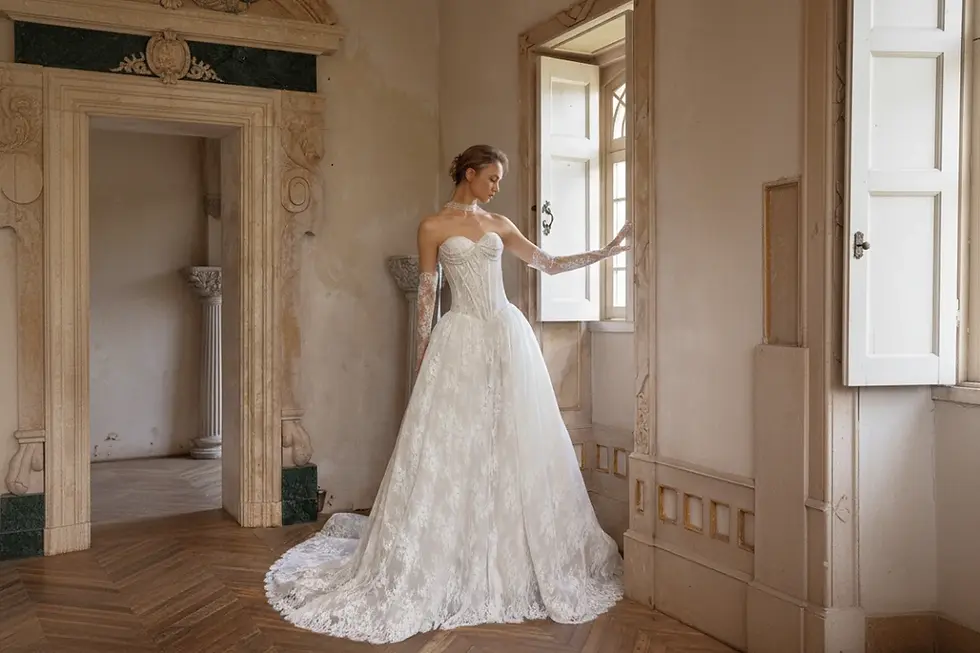
“This gown was designed around the contrast between structure and softness. The bodice gives you that clean, sculpted shape, while the skirt opens with movement so it still feels romantic.”
That is a better conversation.
It helps the bride understand why the gown feels special.
It helps the stylist build value.
And for boutique owners, it helps the dress stand apart from similar silhouettes on the floor.
Structure Is Back — But Softer, Smarter, More Feminine
One reason designer-led collections are becoming more relevant in 2026 is that bridal fashion is moving back toward construction.
Not stiff construction. Not costume.
But shape. Line. Proportion. Waist. Bodice. Movement.
The Knot’s 2026/2027 bridal trend report from New York Bridal Fashion Week noted the return of strong bridal details such as reinvented strapless gowns, basque-drop waist hybrids, long-line corsetry, maximal fabrics, appliqués, draping, and unexpected accessories.
This matters because those details require design judgment.
A basque waist is not just a lowered waistline. If it is cut poorly, it can shorten the body. If it is cut well, it can make the bride look taller, more sculpted, and quietly regal.
A corset bodice is not just exposed boning. If it is too harsh, it looks aggressive. If it is balanced with soft lace, clean satin, or delicate draping, it feels modern and feminine.
A detachable sleeve is not just an extra accessory. It has to look intentional both on and off the dress.
That is where designer-led thinking matters.
Because 2026 bridal is not just about adding more details.
It is about knowing when to stop.

The Rise of Styling Flexibility
One of the most practical reasons boutiques are paying closer attention to designer-led bridal collections is styling flexibility.
Today’s bride often wants more than one look.
Ceremony look. Reception look. Photo look. After-party look.
But not every bride wants to buy two gowns.
That is why detachable elements have become so useful: sleeves, capes, overskirts, chokers, gloves, scarves, boleros, trains, and veils.
They help stylists create a transformation moment inside one purchase.
For boutiques, this is powerful.
A gown with styling flexibility can serve different bride personalities:
The clean bride who wants minimal elegance
The romantic bride who wants softness
The dramatic bride who wants a grand entrance
The modern bride who wants something editorial
The practical bride who wants value from one gown
Calista Couture’s own collection pages highlight versatile design details such as convertible skirts, detachable sleeves, and layering options for personalized styling.
This is not just pretty design.
It is smart merchandising.
A flexible gown gives the boutique more ways to sell the same sample.
And sometimes, that is the difference between a dress that sits and a dress that works.
Why Boutique Buyers Are Looking Beyond Big Names
Big bridal brands are still important. They bring recognition, trust, and broad commercial appeal.
But many boutiques are realizing something:
If every store carries the same famous names, the shopping experience can start to feel familiar.
Too familiar.
A bride may see the same silhouettes online, in another city, or at a competing boutique nearby. That makes differentiation harder.
Designer-led bridal collections give boutiques a way to create freshness without abandoning commercial logic.
They offer the feeling of discovery.
And discovery is valuable.
When a bride walks in and says, “I haven’t seen anything like this,” the boutique has a moment of advantage.
That moment is not only about design.
It is about positioning.
A boutique with a thoughtful designer-led collection can say:
“We choose gowns with a strong point of view.”
“We bring our brides something more personal.”
“We are not just following the market. We are curating.”
That word matters: curating.
The best bridal boutiques are not warehouses of dresses.
They are editors of taste.
What Boutique Buyers Should Look For in a Designer-Led Bridal Brand
Not every designer-led collection is right for every boutique.
A collection can be beautiful and still not be commercially useful.
So what should buyers look for?
1. A Clear Design Identity
You should be able to describe the brand in one or two sentences.
For example:
Modern romantic gowns with sculpted structure and soft French-inspired detailing.
If the collection feels scattered, stylists will struggle to sell it.
2. Commercial Silhouettes With Fresh Details
A boutique does not need ten impossible runway pieces.
It needs gowns that brides can imagine wearing.
The best mix usually includes:
Clean satin or crepe gowns
Romantic lace gowns
A-line or ball gown silhouettes
Fitted mermaid or fit-and-flare styles
One or two detachable styling gowns
One hero statement gown
That gives the floor range without confusion.
3. Strong Construction
A beautiful gown must hold the body well.
Buyers should pay attention to:
Internal corsetry
Bodice support
Seam placement
Fabric weight
How the skirt moves
Whether the gown photographs well
Whether alterations are realistic
A gown can look lovely on a hanger and still fail in the fitting room.
The fitting room tells the truth.
Always.
4. Styling Options
Detachable pieces are not just trend details. They are sales tools.
A gown with removable sleeves, an overskirt, or a cape gives the stylist more ways to personalize the appointment.
That keeps the bride engaged.
It also gives the boutique more perceived value from one sample.
5. A Story Your Team Can Repeat
If your stylists cannot explain the brand naturally, the bride will not feel the value.
A strong designer-led brand should give your team language that feels easy:
“This collection is about structure and softness.”
“This designer uses French-inspired proportions.”
“This gown is for the bride who wants romance, but not something overly sweet.”
Simple. Human. Memorable.
The Calista Couture Perspective
At Calista Couture, we think a designer-led collection should never feel cold or distant.
A gown may begin with proportion, pattern, fabric, and construction.
But it must end with feeling.
Calista Couture is an American original bridal design brand led by designer Cheyenne Cai, whose background includes French fashion education at ESMOD. The brand’s design voice blends American bridal market understanding with French-influenced training, creating gowns that feel refined, emotional, architectural, and feminine.
Our collections are built around a simple tension:
Structure and softness.
A sculpted bodice, but not a hard one.A romantic skirt, but not a weak one.A couture-inspired detail, but not a dress that overwhelms the bride.
In the L’Apogée collection, Calista Couture describes its design language through sculpted lines, luminous textures, and petal-like softness. In À Travers le Temps, the mood shifts toward vintage French romance, lace, embroidery, and sculptural silhouettes.
That is what designer-led bridal means to me.
Not “more complicated.”
Not “more expensive-looking for no reason.”
But more considered.
Every line should earn its place.
Why This Matters for 2026 Bridal Retail
The bridal customer in 2026 is thoughtful.
She has seen a lot.
She has saved hundreds of images. She knows trends before she walks into the boutique. She may not know the language of construction, but she knows when something feels flat.
She can spot a dress that looks generic.
She can also feel when a gown has a soul.
That sounds romantic, I know.
But bridal is romantic.
That is the business.
For boutique owners and buyers, the opportunity is not to chase every trend.
The opportunity is to build a floor that feels intentional.
A floor where every dress has a reason to be there.
A floor where your stylists can say, with confidence:
“Let me show you something different.”
That sentence still works.
Maybe now more than ever.
A Practical Buying Strategy: Start With a Focused Capsule
If you are considering a designer-led bridal collection, you do not need to start with everything.
Start with a focused capsule.
For many boutiques, a smart first order could include:
One clean crepe or satin gown
One romantic lace gown
One A-line or ball gown with strong structure
One fitted gown for the confident modern bride
One gown with detachable sleeves, cape, or overskirt
One hero gown that creates emotion immediately
Six gowns can tell a complete story if they are chosen well.
That is the secret.
Not more dresses.
Better choices.
A capsule like this lets your team test bride response, understand fit, build content, and create a clear selling message without overwhelming the floor.
Final Thought: The Future Belongs to Gowns With a Point of View
Designer-led bridal collections are gaining ground in 2026 because boutiques need more than inventory.
They need distinction.
They need stories.
They need gowns that make brides pause, touch the fabric, look in the mirror, and get that little spark in their eyes.
The spark is the sale before the sale.
A good stylist can feel it.
A good buyer can predict it.
And a good designer knows how to build for it.
In the end, the strongest bridal collections are not the loudest ones.
They are the ones that know who they are.
And when a gown knows who it is, the right bride usually knows too.
FAQ: Designer-Led Bridal Collections in 2026
What is a designer-led bridal collection?
A designer-led bridal collection is a wedding dress collection shaped by a clear creative vision from a designer. It usually has consistent silhouettes, thoughtful fabrics, strong construction, and a story that bridal stylists can explain easily to brides.
Why are designer-led bridal collections popular in 2026?
Designer-led bridal collections are gaining popularity because modern brides want gowns that feel personal, distinctive, and emotionally meaningful. Bridal boutiques also need collections with stronger stories, better construction, and more styling flexibility.
Are designer-led bridal gowns only for luxury boutiques?
No. A designer-led bridal collection can work for many types of boutiques if the gowns are wearable, well-priced for the market, and easy for stylists to sell. The key is balancing design value with commercial appeal.
How many samples should a boutique start with?
Many bridal boutiques can start with a focused capsule of around six gowns. A strong capsule may include clean satin or crepe, romantic lace, an A-line or ball gown, a fitted silhouette, one detachable styling gown, and one statement piece.
What makes a designer-led bridal collection commercial?
A designer-led collection becomes commercial when the gowns are beautiful, wearable, well-constructed, easy to alter, and supported by a clear selling story. The best collections feel special without becoming difficult for real brides to imagine wearing.


Comments